
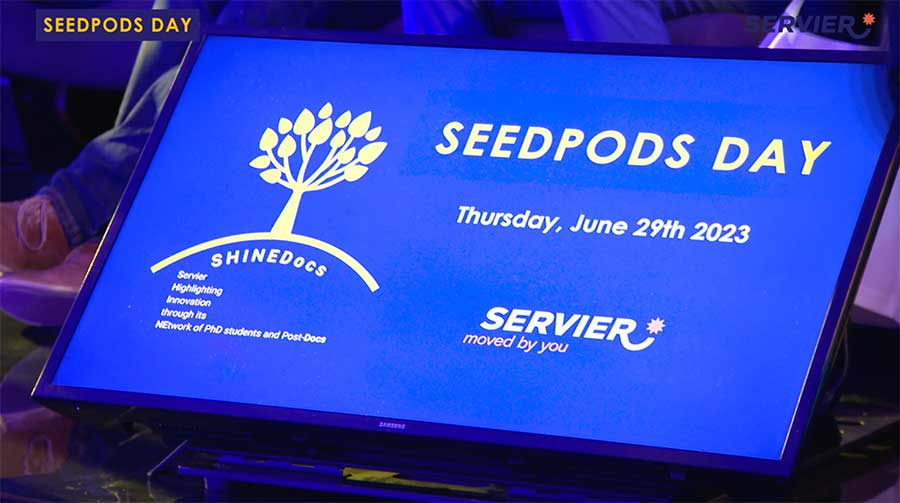
On June 29, SHINEDocs, Servier’s community of young researchers, held the fourth edition of Seedpods Day at our Paris-Saclay R&D Institute. Around thirty international PhD students and post-docs attended the event. Their challenge? To present their research project in three minutes in a manner comprehensible to all. With one objective: accelerate research and innovation to benefit patients.
Behind the Scenes of Seedpods Day 2023
Meeting the Young Researchers at Paris-Saclay
On June 29, at the Servier Paris-Saclay R&D Institute, 36 post-docs and PhD students presented their research to professionals from the corporate world (including Servier), the academic and public spheres. Let’s meet the prize-winners!
First Prize: Faouzi Zarrouki, Post-doc Researcher in Immuno-inflammation
This young Servier post-doc researcher has been awarded the First Prize for the presentation of his research on understanding the neurotoxicity associated with the use of antisense oligonucleotides (ASOs).
“Working in different fields of expertise means that we can take quite a cross-disciplinary approach and learn from each other. It’s inspiring!”
Faouzi Zarrouki, Post-doc Researcher in Immuno-inflammation
Second Prize: Tina Moser, Future PhD, on the Advances in AI and Oncology
Tina Moser’s project looks at the use of artificial intelligence (AI) to fight cancer and increase chances of patient survival. Through her practical research she intends to develop the liquid biopsy technique1.
The jury awarded the third prize to two post-doc candidates, Julie Le Bescont and Selena Bouffette, for their respective work on developing a methodology to improve the candidate-drug synthesis processes, and the understanding of rare diseases and the therapeutic solutions that arise from that.
Audience Prize: Chrisna Matthee
For the first time, the post-doc and PhD candidates were able to vote in parallel for their favorite project. The Audience Prize was awarded to Chrisna Matthee for her research on characterizing the risks associated with pharmaceutical active principles in aquatic environments, particularly in relation to fish.
Prizes for the Two Best Scientific Posters
The first prize for the best poster went to Jérémy Molineau, DDSM PhD student – University of Orléans. It describes his research on using machine learning to predict chromatographic retention.
The second prize went to Estefania Tumbaco Valarezo, neuroscience and immuno-inflammation researcher at the University of Paris-Saclay. The poster sets out her research on the first steps initiating the immunogenicity response to therapeutic proteins.
Research in All Areas
The projects presented explore our therapeutic areas: oncology, immuno-inflammation, and neurosciences. The young researchers particularly distinguished themselves by their projects in cancer and rare diseases where many therapeutic needs remain unmet.
“At Servier, we have always fostered scientific excellence. It is part of our DNA. The Seedpods Day is testament of that: talented people working on high-potential projects in an environment that is open and daring to innovate, a winning recipe for accelerating research at the service of patients. We are proud to have these talents committed to therapeutic progress at our side.”
Olivier Laureau,Servier’s President and CEO.
Seedpods Day: A Singular Event to Boost Innovation
The Annual Event for the Group’s Researchers
Every year for the past four years, Servier’s SHINEDocs community has held the Seedpods Day. This is when PhD students and post-docs working at Servier or a partner laboratory come together to present their research projects to an audience of private-sector experts and public partners.
The event is divided into three parts:
“It is the SHINEDocs community post-docs and PhD students who are the driving force behind the Seedpods Day. An event that brings together talents and Servier employees to boost innovation and reinforce the collaborative spirit between the participants and the network,”
Claude Bertrand, Servier’s Executive Vice President Research and Development
The Seedpods Day for Young Researchers: Share and Exchange with More Experienced Researchers
Coming from France, Denmark, USA or even Hungary, the PhD and post-doc candidates are required to present their project informatively and under three minutes, in the form of a Flashtalk. This tests their eloquence and ability to make their scientific discourse accessible. Prizes are given to the three most qualitative presentations, in acknowledgement of the researchers’ competences and the relevance of their search for therapeutic solutions that meet patient needs.
Throughout the day, the future PhDs also present their research in the form of a scientific poster, sharing the outlines of their project in more detail. Doing it this way promotes interactions with our teams. In fine, these interactions also enable them to enrich their reflection and identify opportunities in their field.
For Servier: Support Post-docs and PhD Students
We offer post-doc and PhD researchers close support in developing their soft skills. With the Seedpods Day, and as laboratory of excellence, we help post-doc and PhD researchers to refine their project as part of an experience-sharing approach. We also support them when it comes to public speaking.
The Seedpods Day is also an opportunity for Servier to stimulate R&D and accelerate research within its therapeutic areas. We fund the projects and support the development of young SHINEDocs program researchers. The event fosters open innovation, an essential lever for boosting the search for candidate drugs to meet patient needs across the Group’s therapeutic areas. In participating, the Servier collaborators meet new methodologies that nourish their field of expertise.
“Post-doc and PhD researchers are essential to the candidate-drug discovery process. This community reinforces the link between private sector and public players. They bring the open innovation that we are looking for, without limits to their reflection.”
Claude Bertrand, Servier’s Executive Vice President Research and Development
Our R&D Institute on the Paris-Saclay campus opened its doors in February 2023. Our decision to set up within the Paris-Saclay ecosystem was no coincidence. It should enable us to converge our innovation potential within a powerful ecosystem and hub of scientific excellence. By choosing Paris-Saclay, we also commit to local economic growth and supporting the attractiveness of research in France.
Post-docs and PhD Students at Servier
Post-doc and PhD Researchers: Their Roles in a Research Laboratory
A PhD student does his thesis on a given subject. A post-doc is a researcher with a PhD and a temporary contract with a research laboratory. Both are young researchers committed to therapeutic progress.
Why Do a Post-doc?
It is a veritable process that structures the researcher’s identity. Doing a post-doc enables the researcher to build on the experience acquired during their thesis by refining their scientific profile within a community of experts. This enables them to focus on research centers of particular interest when looking for employment. The researchers also enjoy a training offer provided by the host establishment, such as Servier.
SHINEDocs : le programme d’accompagnement Servier auprès des jeunes chercheurs
For post-docs and PhD students, working with Servier is an opportunity to understand the workings of a pharmaceutical industry and the challenges of the private sector, and thereby find therapeutic solutions that meet patient needs. It is an excellent way for them to give their project meaning and tailor it, if necessary, to actual patient needs. In addition, each young researcher is free to conduct their project in the partner establishment of their choice.
Finally, for a company like Servier, collaborating with today’s researchers is essential.
“Each player alone at their own level is unable to develop revolutionary projects for patients. The individual expertise of the academics and public sector players complement our industry expertise as a private sector player. As part of the projects conducted with post-docs or PhD holders, we share a common ambition and long-term vision: provide patients with therapeutic solutions.”
Nadège Berson, Innovation Project Manager in charge of the SHINEDocs community.
[1] A liquid biopsy is a set of blood tests used to help diagnose cancer (excluding blood cancer) by identifying the DNA of cancerous cells in the blood. This represents a particularly promising research field for the coming years and an effective alternative to the repetitive conventional biopsies that are complex to perform.
[2] Computational medicine is a recent discipline that links the collection of data from artificial intelligence with their analysis and use in conventional medicine. It is at the crossroads between computer science, data science, and conventional medicine.