
By “clinical trials,” we mean the series of scientific studies carried out in humans that validate the research and development stages in the medicine discovery process.
This crucial step is subject to rigorous regulatory controls, for the purpose of obtaining a marketing authorization and determining the optimal use of a medicinal product to ensure therapeutic benefit for patients.
Clinical trials can last several years and must follow specific organization that complies with stringent research protocols to ensure participant safety.
Clinical research requires scientific rigor
The term clinical research comprises all scientific studies carried out on volunteers in order to develop medicines and medical devices.1 Clinical trials are usually conducted in a hospital setting or a doctor’s office, under the supervision and responsibility of physicians.
Clinical trials are used to assess the safety, efficacy, and use of treatment in humans so that a new medicine can be made available on the market. They require the application of a rigorous scientific method in order to guarantee both the therapeutic benefit of the proven solution and participant safety. In addition to its therapeutic interest, clinical research also contributes to further developing medical and biological knowledge.2
The four phases of clinical trials
Pre-clinical trial validation is a prerequisite for starting a clinical trial. This phase involves testing the molecular entity on animals before administering the drug candidate to humans.
The development of a new medicinal product typically consists of four successive phases of clinical trials, which aim to observe the effects of the drug in the human body and measure its effectiveness.
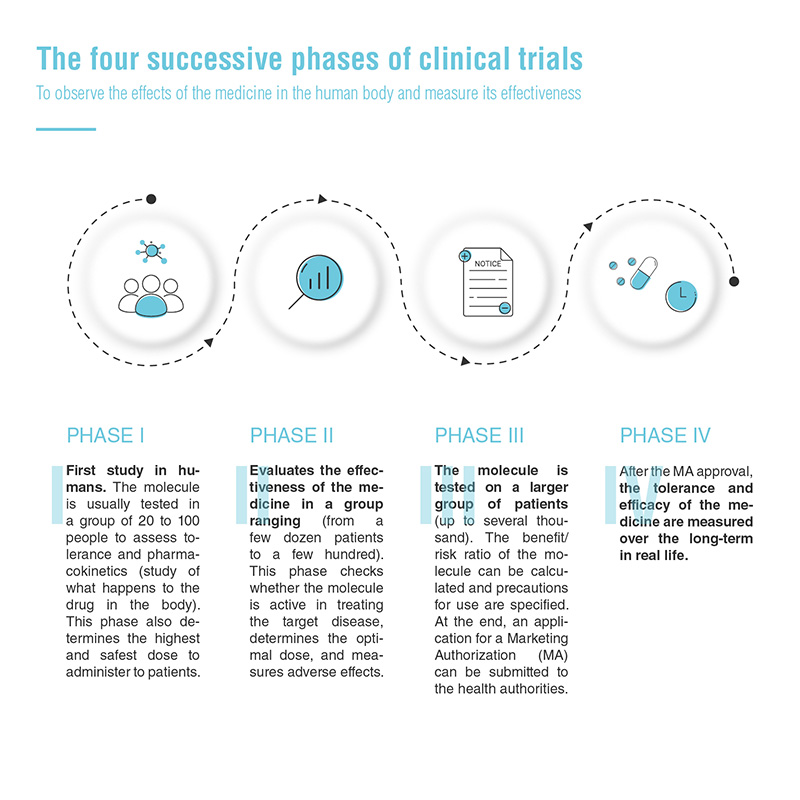
Currently, only one in ten medicines passes all four phases.3 However, for oncology or a rare disease, the clinical development process of a medicine can be accelerated: there can be fewer patients and certain development phases may be combined.
Pharmaceutical companies, researchers, doctors, and patients all play a part!
Clinical trials generally take several years – sometimes up to ten years – and entail the daily commitment and efforts of numerous stakeholders in order to find new therapeutic solutions that are vital for treating patients.
Most often, pharmaceutical companies initiate clinical trials and are responsible for their funding. All clinical trials are carried out by qualified health care professionals, called investigators. They are in charge ensuring they are carried out properly, and are responsible for the inclusion of patients in the study and for their safety. As for participants, they are always volunteers.
Ensuring transparent results within a stringent legal framework
To start a clinical trial, various authorizations are required from the relevant authorities of each country. Approval times vary from country to country (from 30 days to over 200 days).
Each participant must receive all information relating to the study in writing (including benefits and risks) and must give their consent by signing an informed consent form before being selected. The Nuremberg Code and the Declaration of Helsinki of 1964, as well as their successive updates, define the ethical principles of medical research worldwide.
The publication of the results of a clinical trial is of major interest to medical and scientific research because it helps to ensure the transparency of results, whether positive or negative. The Declaration of Helsinki stipulates that “medical research involving human participants must be registered in a publicly accessible database before recruitment of the first participant.”

New challenges ahead

AND SERVIER?
The Group’s clinical trials are managed by teams with the highest standards. Good organization is required to carry out trials properly, and involves teams in charge of international coordination and locally in 19 clinical development centers divided into three hubs, making it possible to manage clinical studies worldwide.
Servier publishes 100% of the results of its European clinical trials on the European Union’s Clinical Trials Information System website.
Servier also publishes all of its trials on its website clinicaltrials.servier.com, with the exception of trials in phase I. This website enables easy access by patients, health care professionals and the general public to the Group’s clinical trials information and results.
Servier is committed to involving patients, directly or through patient organizations, to develop medicinal products that best meet their needs. Collaboration may pertain to clinical trial protocols, the development of consent forms and patient awareness brochures, patient feedback following a study, and preparing summaries of study results that are written in clear language and accessible to the general public.
Digital technology and data increase agility, efficiency and productivity to speed up the research process, the iterative molecule identification procedure and clinical trials, while also developing a more detailed understanding of patients. SCORE, the Servier program that digitizes clinical trials, is a part of this ambition as it encourages remote dialogue between patients and medical and scientific teams. Data can be accessed in real time, facilitating decision making. The Group’s FEDERATES platform improves the communication of information and data in real time and accelerates the various research stages.
1 https://clinicaltrials.servier.com/about-clinical-trials/
2 https://www.inserm.fr/recherche-inserm/recherche-clinique
3 https://www.leem.org/recherche-et-developpement
4 https://www.clinicaltrials.gov/ct2/help/glossary/phase
5 Goldacre Ben, DeVito Nicholas J, Heneghan Carl, Irving Francis, Bacon Seb, Fleminger Jessica et al. Compliance with requirement to report results on the EU Clinical Trials Register: cohort study and web resource BMJ 2018; 362 :k3218