
Chronic venous disease (CVD) affects a large number of people worldwide. It is caused by the inflammation of the veins.
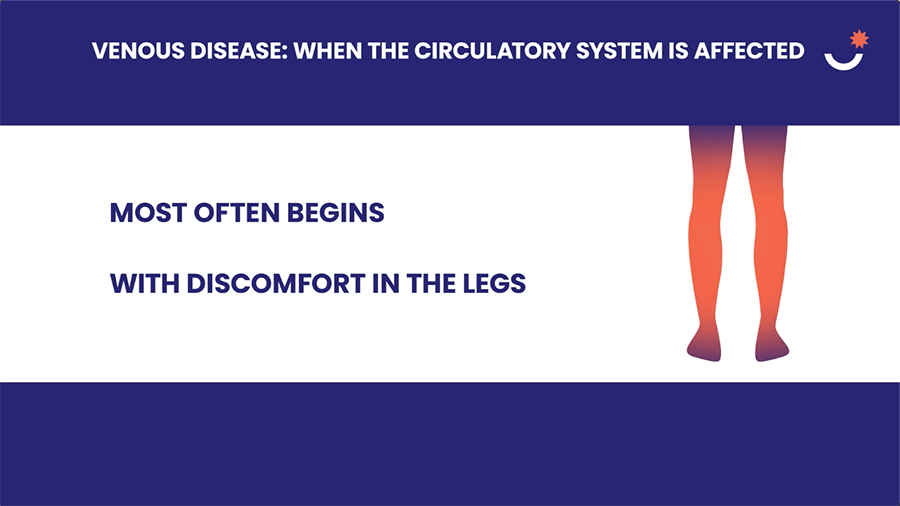
CVD most often begins with discomfort in the legs, , and may progress gradually to varicose veins, edema, skin hyperpigmentation (discoloration), and ulcers in advanced stages. It is sometimes complicated by superficial or deep vein thrombosis (DVT), which is when a clot forms in a blood vessel and obstructs it. 22% of patients with varicose veins associated with reflux developed a venous leg ulcer within 6 years1.
CVD is correlated with cardiovascular diseases and risk of all-cause mortality starting from the early stages of CVD and this risk increases with the progression of the disease2.
Moreover, CVD impact quality of life, as other disabling and impairing chronic diseases such as diabetes, obesity, and hypertension. With the progression of chronic diseases, the need for treatment increases while the quality-of-life decreases. Although these chronic conditions are typically considered as separate entities, they often co-exist which may be important in both understanding their pathophysiology and determining the best treatment strategy.
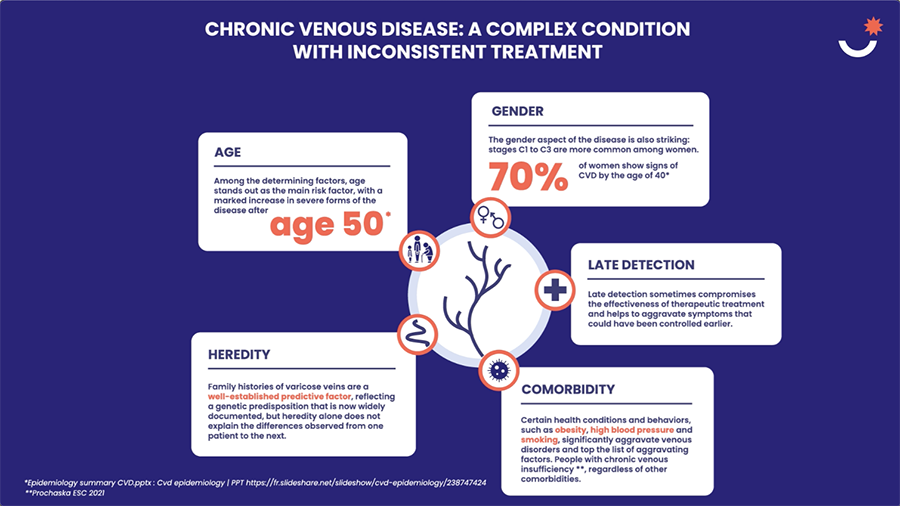
Venous diseases are the most common diseases in the world. According to several studies summarized in a 2021 publication in the Journal of Minerva Medica, Varicose veins are present in 25%-33% of female and 10%-40% of male adults3. The prevalence of CVD is highest up to 70% in Eastern Europe4. The disease consumes up to 2% of healthcare budgets in western countries5.
The main cause: poor circulation in the veins
What are the risk factors for venous diseases?
Several risk factors can be associated with the onset of venous diseases. Patients can take action on those related to circumstances or lifestyle.
These include excess weight, level of physical activity, and standing for prolonged periods – all of which increase the likelihood of developing venous diseases. Furthermore, women are at greater risk than men, notably during pregnancy, the increased volume of the uterus compresses the veins in the abdomen, making it more difficult for venous blood to flow back up from the legs to the heart. Finally, venous disease can also be linked to genetic factors, and also increases the likelihood of developing this condition.
How are venous diseases treated?
Regular physical activity, such as walking or swimming, along with weight control, a balanced diet and cessation of smoking are among the various options available to patients for preventing the onset or progression of the disease. Treatments are available today according to the stage of the disease. Patient education, physical activity, elevating the legs and keeping weight in check may slow its progression. Mechanical methods such as elastic compression stockings or socks can reduce the pressure of the blood on the valves. Use of venotonics can improve the symptoms associated with venous disease, as a complement to healthy lifestyle measures. Existing varicose veins are either surgically removed or sealed shut using radiofrequency or, laser, or the injection of a chemical solidifying agent (sclerotherapy)6.

About Servier
Servier works alongside health care professionals and patients to better understand venous insufficiency and treat the symptoms.
REMEMBER
[1] M R Cesarone, G Belcaro, A N Nicolaides, et al. ‘Real’ epidemiology of varicose veins and chronic venous diseases: the San Valentino Vascular Screening Project. Angiology. 2002;53(2):119-30. doi: 10.1177/000331970205300201.
[2] Prochaska JH, et al. Eur Heart J 2021; 42:4157-65 (https://pubmed.ncbi.nlm.nih.gov/34387673/)
[3] Management of chronic venous disorders of the lower limbs. Guidelines According to Scientific Evidence. Part I – International Angiology 2018 June;37(3):181-254 – Minerva Medica – Journals (https://www.minervamedica.it/en/journals/international-angiology/article.php?cod=R34Y2018N03A0181)
[4] Vuylsteke ME, et al. Angiology. 2018;69(9):779‒785 (https://pubmed.ncbi.nlm.nih.gov/29482348/)
[5] E Rabe, F Pannier. Societal costs of chronic venous disease in CEAP C4, C5, C6 disease. Phlebology. 2010:25 Suppl 1:64-7. doi: 10.1258/phleb.2010.010s09
[6] De Maeseneer MG, et al. Eur J Vasc Endovasc Surg. 2022 Feb;63(2):184-267