
Types of epilepsy associated with the KCNT1 gene affect only a very small number of children worldwide. Beginning in the first few months of life, these children develop severe epileptic seizures — often resistant to treatment — that compromise their neurological development.1, 2 For quite some time, treatment focused primarily on controlling seizures. Today, recent advances in genetics and targeted therapies are paving the way for new approaches, directly targeting the molecular mechanism responsible for the disease.
A genetic anomaly at the root of the disease
KCNT1-related epilepsy disorders are classified as developmental and epileptic encephalopathies (DEE), a group of diseases frequently associated with an identifiable genetic anomaly.2 These rare disorders typically begin prior to one year of age and involve severe epilepsy, developmental delays, cognitive, motor, and behavioral impairments, as well as a high risk of early death.4
The first years of life are crucial for brain development,2 as neural circuits are forming at an extraordinary rate.
The associated developmental difficulties stem from a genetic defect that affects the brain during its earliest stages of development. Seizures further exacerbate an already compromised situation. With this insight, researchers have been focusing on treatments capable of both reducing seizures and preserving neurological development — a major step forward compared with only addressing the symptoms.
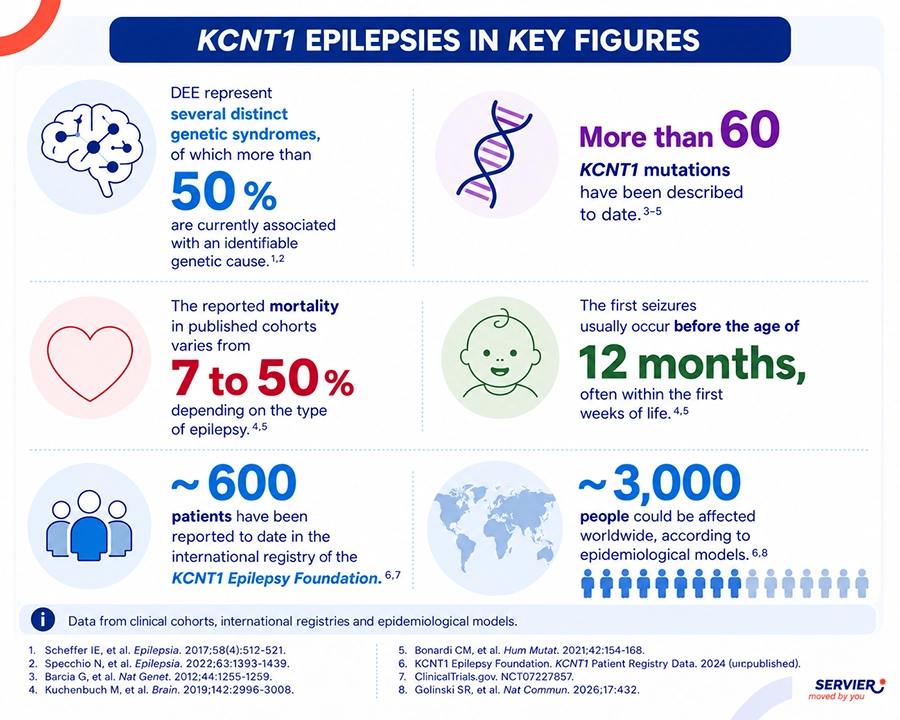
KCNT1-Related Epilepsy: Key figures
Over 60
The number of pathogenic variants of KCNT1 that have been identified to date.³⁻⁵
Before 12 months
The age at which the first seizures generally appear, sometimes as early as the first weeks of life.⁴,⁵
50 %
DEEs comprise several distinct genetic syndromes, more than 50% of which are now linked to an identifiable genetic cause.1,2
A very rare and underdiagnosed disorder
KCNT1-related epilepsies are among the least common of all pediatric neurological disorders. The main challenge lies in diagnosing the condition early enough, since the initial symptoms can be mistaken for those of other neurological conditions. Improved access to genetic testing could lead to a more rapid and accurate diagnosis, thereby allowing care to be better-suited to the patient.
Did you know?
The KCNT1 Epilepsy Foundation reports that more than 590 individuals worldwide have been identified with the condition to date, but its true prevalence remains unknown.9
KCNT1: The genetic abnormality behind the disease
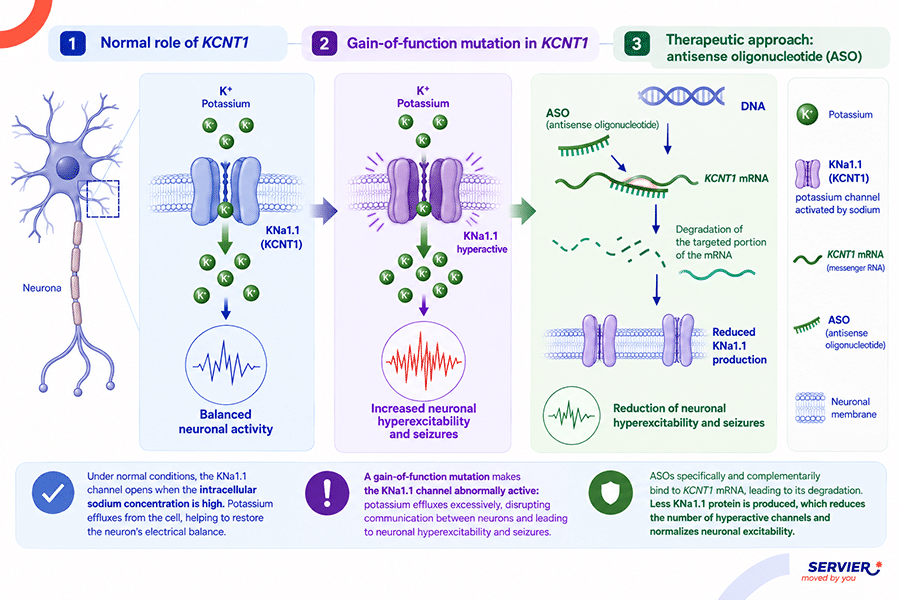
The KCNT1 gene encodes a protein, the KNa1.1 potassium channel, which helps regulate the electrical activity of neurons.3,6 Under normal conditions, this channel opens when sodium enters the neuron and allows potassium to exit, thereby helping to maintain the neuron’s electrical balance. In most children with the condition, a so-called “gain-of-function” (GOF) mutation causes this channel to become abnormally active, disrupting the neural network function and contributing to the hyperexcitability that triggers seizures.3,6 Understanding how this mechanism works can lead to therapeutic approaches that more directly target the biological cause of the disease.6 This is precisely the underlying principle of antisense oligonucleotides (ASOs).
Therapeutic revolution: Targeting the cause of the disease
Current treatments can sometimes reduce seizures but have no effect on brain development, which is why they are often found to be inadequate. This is the greatest challenge in the treatment of KCNT1-related forms of epilepsy. Most children have drug-resistant epilepsy, and no current treatment can alter the natural course of the disease.5
The lack of effective therapies has led to growing interest in antisense oligonucleotides (ASOs). Unlike conventional antiseizure medications, which target the pathways or the neuronal electrical balance to reduce hyperactivity, ASOs restrict the activity of the channels causing the hyperactivity.6 In this case, short sequences of nucleic acids specifically recognize the messenger RNA of the KCNT1 gene and reduce quantities, thereby limiting production of the abnormal protein.6

ASO: A precision technology that brings new treatment perspectives
Recent developments in precision medicine R&D have seen antisense oligonucleotides (ASOs) deliver on their promise to revolutionize the treatment of rare genetic diseases, which, in most cases, are severely disabling and often lack adequate treatment options.
Read our insightMeasuring what really matters to patients
In cases of DEEs, demonstrating the effectiveness of a treatment involves more than just counting seizures. It also requires assessing tangible improvements in neurological development.
When it comes to rare childhood diseases, demonstrating the effectiveness of a treatment is particularly complex. Clinical trials involve small numbers of patients, and a mere reduction in the frequency of seizures does not always reflect the improvements observed by families. For them, clinical benefits can take very concrete forms, such as seeing their child make eye contact, smile, respond to their name, sit up, learn a new movement, communicate better, or interact more with those around them. These advances — sometimes subtle but nevertheless essential — are among the factors that must be considered when assessing the progression of neurodevelopmental disorders.2 Researchers now combine seizure frequency, electroencephalograms (EEG), biomarkers, motor development, social interactions, communication, and quality of life to more comprehensively assess a child’s progress.

About Servier
In 2024, Servier strategically decided to make rare neurological diseases the next growth driver. Since then, the Group has been expanding its research pipeline and bolstering expertise with the aim of becoming a global player in the field by 2030.
Servier’s priority is to address the biological causes of neurological diseases that are primarily genetic in origin and severely debilitating, including KCNT1-related epilepsy.
References
[1] Scheffer IE, Berkovic S, Capovilla G, et al. ILAE classification of the epilepsies: Position paper of the ILAE Commission for Classification and Terminology. Epilepsia. 2017;58(4):512-521. doi:10.1111/epi.13709.
[2] Specchio N, Wirrell EC, Scheffer IE, et al. International League Against Epilepsy classification and definition of epilepsy syndromes with onset in childhood: Position paper by the ILAE Task Force on Nosology and Definitions. Epilepsia. 2022;63(6):1398-1442. doi:10.1111/epi.17241.
[3] Barcia G, Fleming MR, Delignière A, et al. De novo gain-of-function KCNT1 channel mutations cause malignant migrating partial seizures of infancy. Nat Genet. 2012;44(11):1255-1259. doi:10.1038/ng.2441.
[4] Kuchenbuch M, Chemaly N, Henniene KM, et al. KCNT1 epilepsy with migrating focal seizures shows a temporal sequence with poor outcome, high mortality and SUDEP. Brain. 2019;142(10):2996-3008. doi:10.1093/brain/awz240.
[5] Bonardi CM, Heyne HO, Fiannacca M, et al. KCNT1-related epilepsies and epileptic encephalopathies: phenotypic and mutational spectrum. Brain. 2021;144(12):3635-3650. doi:10.1093/brain/awab219.
[6] Burbano LE, Li M, Jancovski N, et al. Antisense oligonucleotide therapy for KCNT1 encephalopathy. JCI Insight. 2022;7(22):e146090. doi:10.1172/jci.insight.146090.
[7] Nakayama T, El Achkar CM, Burbano LE, et al. Antisense oligonucleotide-mediated knockdown therapy in two infants with severe KCNT1 epileptic encephalopathy. Nat Med. 2026;32:1411-1420. doi:10.1038/s41591-026-04314-9.
[8] Golinski SR, Soriano K, Briegel AC, et al. RNA targeting therapy for a prenatally enriched potassium channel associated with severe childhood epilepsy and premature death. Nat Commun. 2026;17:5864. doi:10.1038/s41467-026-72334-7.
[9] Gras M, Quentin-Romand G, Chemaly N, Barcia G, KCNT1 Consortium, Nabbout R. Expanding the phenotypic and genotypic spectrum of KCNT1-related epilepsies. Brain Commun. 2026;8(4):fcag256. doi:10.1093/braincomms/fcag256.