
Becker muscular dystrophy is a rare, X-linked genetic disorder that causes progressive muscle wasting. There is currently no approved treatment for patients. The loss of muscle function is irreversible and affects patients’ ability to perform daily activities such as walking. What do we know about its wide variety of forms, and how is research attempting to preserve muscle function?1,2
A rare disease, very different journeys
Becker muscular dystrophy affects approximately one in 18,500 live male births.3 It causes progressive muscle weakness. It often manifests as difficulty running, climbing stairs, or getting up from the floor, sometimes accompanied by pain, cramps, and increased fatigue. The first signs can appear at very different ages, and the course of the disease varies greatly from person to person.1–4 This diversity can delay diagnosis, particularly when a person’s strength still appears to be intact.
Symptoms may be noticed in childhood, adolescence, or adulthood, although many people diagnosed later in life recognize signs and experiences that began much earlier. No matter the age of symptom onset, Becker can still lead to substantial loss of independence and quality of life. 2,4
Becker Muscular Dystrophy: four key facts
Becker Muscular Dystrophy is estimated to have a global prevalence of approximately 1.6 per 100,000 people, with an incidence of approximately 1 in 18,500 live male births.3
It affects 5,000 to 6,000 male patients in the U.S. and around 35,000 people are diagnosed across the US, EU4 (France, Germany, Italy, UK), Japan and China.
The same gene, DMD, is involved in both Becker and Duchenne muscular dystrophy.1
Muscle and heart involvement do not necessarily progress at the same rate.1,6
Dystrophin, a compromised line of defense
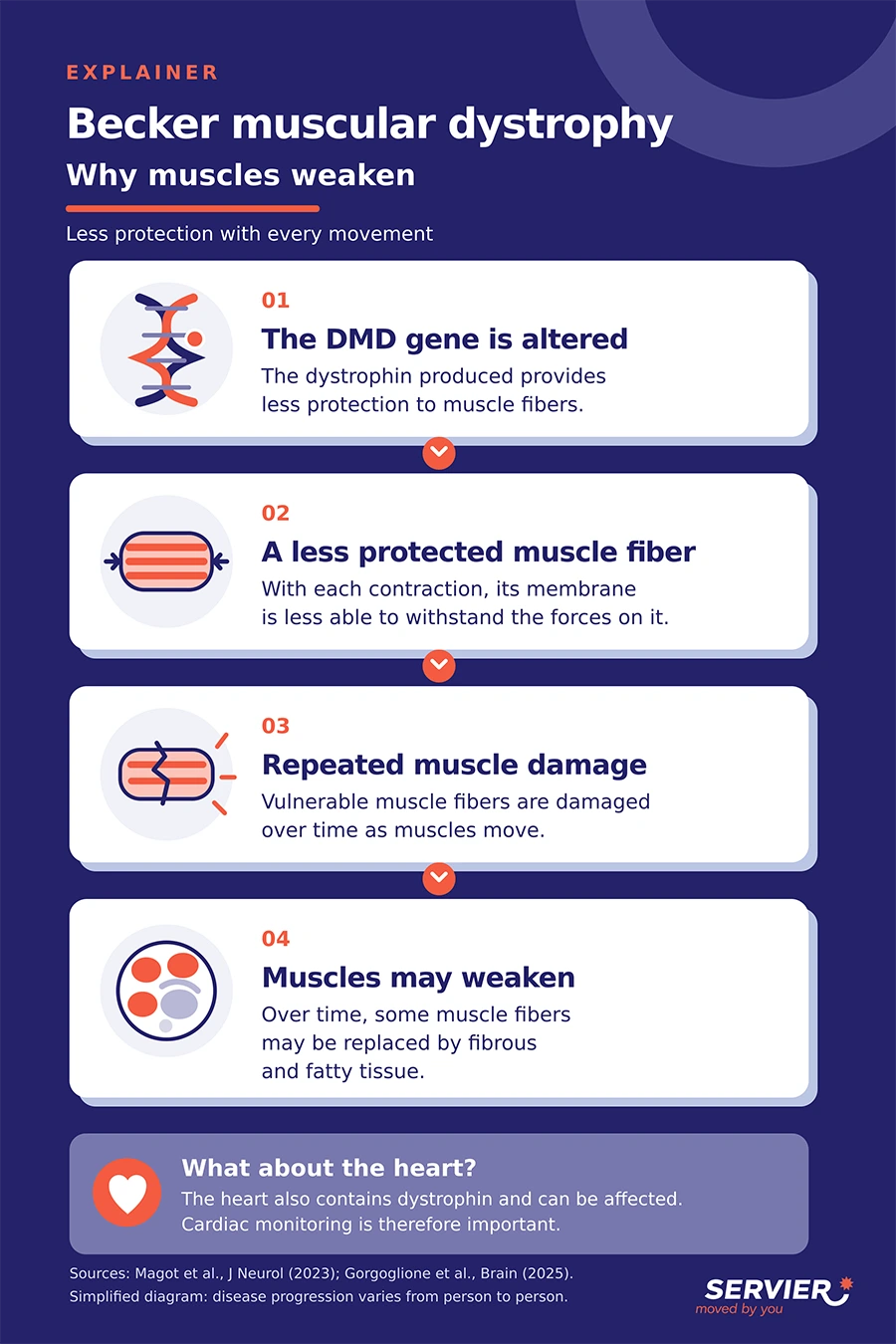
The DMD gene, located on the X chromosome, is responsible for the production of dystrophin, a protein essential for proper muscle function. When this gene is affected by a mutation, as in Becker muscular dystrophy, dystrophin is produced in insufficient quantities or in a less effective form. Muscle fibers then become more fragile and gradually deteriorate with each muscle contraction. Over time, some of the muscle tissue may be replaced by fibrous or fatty tissue.1–4
Duchenne and Becker muscular dystrophies belong to the same family of disorders, known as dystrophinopathies. Both are caused by mutations in the DMD gene. In Becker muscular dystrophy, dystrophin remains partially functional. This helps explain the differences in how the disease progresses from one person to another and over time. However, some people with Becker muscular dystrophy may experience significant muscle impairment or cardiac complications.1,2
Beyond the muscles: monitoring the heart as well
Certain signs, such as progressive muscle weakness or abnormal blood test results, may lead physicians to investigate Becker muscular dystrophy. Genetic testing can now confirm the diagnosis in most cases. Diagnosis is also important for supporting families and informing them about inheritance risks.1,5
While there currently is no standard of care for how to monitor heart health in Becker, cardiac monitoring is essential from the time of diagnosis, even in the absence of apparent cardiac symptoms. The heart also contains dystrophin, and cardiac muscle involvement may progress silently. Specialists may rely on electrocardiography (ECG), echocardiography, or cardiac MRI to monitor patients’ heart health. Follow-up care also includes respiratory health, bone health, pain management, and each patient’s psychological needs.1,5,6
Why cardiac MRI?
Cardiac MRI can detect certain abnormalities before a decline in cardiac function becomes apparent and plays an important role in monitoring cardiac involvement in Becker muscular dystrophy. While there is currently no universally established standard of care for cardiac monitoring in Becker, cardiac MRI is increasingly used alongside echocardiography and other cardiac assessments.6
Pain and fatigue also deserve active discussion at follow-up visits. People may gradually change how they move to compensate for weakness, which can place additional strain on other muscles. Because pain is often managed informally or not raised with a clinician, care may include identifying triggers, reviewing activity and rehabilitation plans, and considering individualized pain-management support.4,5
Preserving health and autonomy over time
There are currently no medications specifically approved to slow the progression of Becker muscular dystrophy. Management is based on regular monitoring and combines surveillance and treatment of cardiac complications, rehabilitation, guidance on appropriate physical activity, and support for challenges encountered at school, at work, or in everyday life. Decisions depend on age, functional abilities, symptoms, and follow-up findings. Experts emphasize the value of a multidisciplinary team involving neurologists, cardiologists, physiotherapists, and, when necessary, other healthcare professionals.1,5
One of the key challenges is recognizing early enough the changes that affect patients’ daily lives: increased fatigue after an ordinary day, a journey that has become more difficult, or the need to adjust activities. Paying close attention to the patient experience is also valuable for designing clinical studies and interpreting their results.5
Living with Becker muscular dystrophy: key insights
∼50%
Nearly half of individuals with Becker muscular dystrophy lose the ability to run in their early 30s.
∼30-40%
Approximately 30-40% are no longer ambulatory in their 40s or 50s.
86%
of patients report experiencing pain or fatigue during a one-year period.
One commonly used tool is the North Star Ambulatory Assessment (NSAA), which evaluates 17 everyday motor activities such as standing, walking, climbing steps, rising from a chair or from the floor, hopping and running. Scores range from 0 to 34, with higher scores reflecting greater independence. Even a one-point decline can represent a meaningful change in daily life, such as needing help to climb stairs or get up after a fall.
| NSAA activity | Real-life meaning |
|---|---|
| Rising from a chair | Using the toilet independently |
| Rising from the floor | Getting up after a fall |
| Climbing steps | Managing stairs and curbs |
| Standing on one leg | Getting dressed while standing |

About Servier
In 2024, Servier made the strategic decision to make rare neurological diseases its next growth driver. Since then, the Group has been expanding its research portfolio and strengthening its expertise with the goal of becoming a global leader in this field by 2030. Servier intends to prioritize addressing the biological causes of neurological diseases that are primarily genetic in origin and severely disabling.
In July 2026, Servier completed the acquisition of Edgewise Therapeutics’ muscular dystrophy business. This acquisition supports Servier’s strategic ambition in rare neurological diseases with a potential treatment for Becker and Duchenne muscular dystrophies. The acquired asset and team of experts have strengthened Servier’s commitment to innovation for the benefit of patients with significant unmet medical needs.
References
[1] Magot A, Wahbi K, Leturcq F, et al. Diagnosis and management of Becker muscular dystrophy: the French guidelines. J Neurol. 2023;270:4763–4781. doi:10.1007/s00415-023-11837-5.
[2] Gorgoglione D, Sabbatini D, Riguzzi P, et al. Natural history of Becker muscular dystrophy: DMD gene mutations predict clinical severity. Brain. 2025;148:1695–1706. doi:10.1093/brain/awae358.
[3] Salari N et al. Global prevalence of Duchenne and Becker muscular dystrophy: a systematic review and meta-analysis. J Orthop Surg Res. 2022;17:96. doi:10.1186/s13018-022-02996-8.
[4] Mickle AT, Johnston KM, Ricchetti-Masterson KL, et al. The natural history of Becker muscular dystrophy: A systematic literature review. J Neuromuscul Dis. 2026. doi:10.1177/22143602261420045.
[5] European Neuromuscular Centre. 290th ENMC International Workshop: Developing Standards of Care for patients with Becker Muscular Dystrophy. Novembre 2025. enmc.org/download/developing-standards-of-care-for-patients-with-becker-muscular-dystrophy-bmd/
[6] McDiarmid A, Augustine D, Coats C, et al. Cardiac MRI in cardiac dystrophinopathy: recommendations on imaging. Open Heart. 2026;13:e004037. doi:10.1136/openhrt-2026-004037.