
AI, the next chapter in our digital transformation
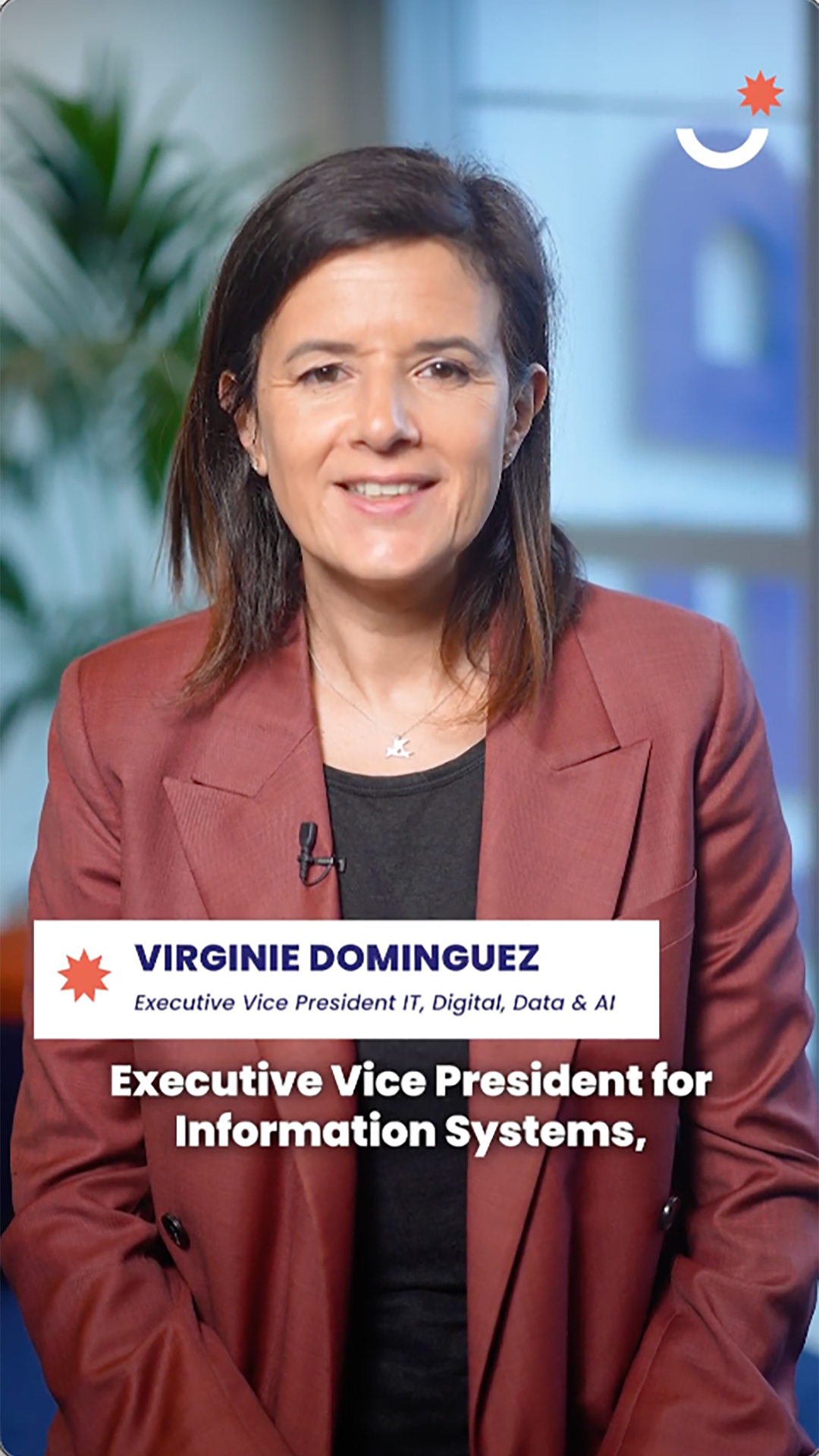
“Will AI cure everyone in the future?” When invited to respond to this question during a roundtable discussion at AIM (Artificial Intelligence Marseille) on November 14, 2025, Virginie Dominguez, Executive Vice President, Digital, Data and Information Systems, explained that AI serves three major purposes at Servier: “speeding up therapeutic innovation, bringing new services to patients and health care professionals, and improving our efficiency and sustainability throughout the value chain.” Far more than just a passing trend, AI is now a strategic driver for tackling major challenges in health care, innovation, and sustainable performance.
A clear ambition: Become best-in-class with the help of digital technology, data, and AI
Servier has set the goal of becoming best-in-class by leveraging digital technology, data, and AI as a way to organically integrate this technological revolution. Investments made in recent years have helped the Group reach a solid level of maturity and even get ahead in some key areas. This momentum is now setting the stage for a new phase of acceleration, with a particular focus on therapeutic innovation, patient support, and operational excellence.
Focus on AI in R&D
Reflecting our 2030 ambition, 50% of our data and AI resources are used to advance our research and expedite the discovery and availability of new treatments. “One of our ambitions is to reduce the new medicine development time (the current average is 10- to 15-years) by two to four years,” explains Virginie Dominguez. How? The first step is to equip ourselves with the means to analyze huge databases (genomic, proteomic, chemical) so that we can identify therapeutic targets or promising molecules in record time. AI is a valuable ally in precision medicine and in pinpointing the patient focus of our research projects.
New-generation screening (HTS – High Throughput Screening – Hits Validation) is used to sift through huge databases of molecules to predict the ones that correspond to the biological target.
Artificial intelligence doesn’t just sort, it streamlines. By using common performance criteria present among multiple research projects, AI can immediately rule out anything that presents a risk of toxicity or chemical incompatibility. This means that only the most promising molecules proceed to development. By reducing attrition (failure rate), our resources are focused on drug candidates that have a real chance of reaching patients.
No AI without data
At Servier, AI could double the probability of success for our drug candidates. Currently, only 12% of candidates entering clinical trials worldwide are ultimately approved for patient use1.
“There is no AI without data, and depending on the choices made, we can obtain tremendously different results. The challenge is to choose the right data on which to run our AI in order to get the right results. That’s why it’s so important to conduct our clinical trials with as much diversity as possible.”
Focus: AI in clinical trials
AI makes it possible to better predict the toxicity of a molecule before it undergoes clinical trials. How is the molecule absorbed by the intestine? Is it stable in the liver? How is it eliminated? What is its potential toxicity? Using machine learning models trained on hundreds of previous molecules, AI performs in silico tests (virtual) to predict how the medicine will behave in the body. This is known as “molecular property prediction.”
A deliberate strategy: Partnering with the best to drive progress
Aware that the battle for innovation cannot be won alone, Servier has opted for a balanced strategy combining in-house developments, targeted acquisitions, and leading-edge technology partnerships, each addressing a critical link in the drug value chain. The goal is to speed up the discovery of new therapeutic solutions for patients.
Two major technology partnerships forged in early 2026 attest to the Group’s maturity level in this area:
Our partnership with China-based Insilico Medicine will allow us to more quickly identify new drug candidates for complex oncology targets.
Our collaboration with Iktos, France’s leading artificial intelligence and robotics company, will focus on designing, synthesizing, and optimizing small molecules for several biological targets, particularly in oncology and neurology.
On the precision medicine front, our strategic partnership with French unicorn Owkin will help us analyze massive amounts of clinical data. The aim is to identify subgroups of patients according to defined biological markers, in the hope that they will respond best to treatment.
Servier partners with Owkin with the aim of discovering and developing AI-driven therapeutics
We are also partnering with Aitia, the market leader in digital twins and causal AI technology. Together, we are developing “Gemini” digital twins to identify new therapeutic targets in pancreatic cancer, Parkinson’s disease, and glioma.
Servier and Aitia: An extensive collaboration to personalize and identify new treatments
Last but not least, to help drive this massive transformation, we’re continuing our long-standing partnership with Google Cloud, whose computing power and infrastructure are key to rolling out generative AI worldwide. We are incorporating Google Cloud’s AI solutions to advance our R&D programs to serve patients, and we are expanding the use of AI and generative AI to other strategic areas of the Group to optimize our entire value chain.
[1] Innovation in the pharmaceutical industry: New estimates of R&D costs; Revue: Journal of Health Economics, Volume 47, pages 20-33; Mai 2016. https://dukespace.lib.duke.edu/server/api/core/bitstreams/27f540a1-e371-42ee-a13a-27f490f5f2c3/content