
When something doesn’t feel right
I never thought my body would warn me in such a quiet way. In April 2024, nothing seemed particularly alarming. And yet something had changed. Going to the bathroom became more difficult and required more effort than before. That alone made me suspicious.
Weeks passed, and the difficulties did not go away.
In July 2024, I decided to see a proctologist. An abscess was discovered that required a first surgery, then a second one. Each time I hoped it would be enough. But despite the operations, the symptoms persisted. In fact, they became even worse, which confused the proctologist.
Looking for answers
At my insistence, an endoscopy and a colonoscopy with tissue sampling were performed. I assumed that nothing serious would come out of it—just like all the other unusual health issues I had experienced in my life. That’s why I went to the appointment feeling neutral when the results came in a week later.
The analysis of a tissue sample led to the diagnosis: colorectal cancer (rectal carcinoma). Hearing this diagnosis was frightening. I had hoped for answers, but I was not prepared for that word, and it took me a moment to fully grasp everything. For a while my thoughts raced between disbelief and questions about what this diagnosis meant for the rest of my life. Gradually, I shifted from shock to a more practical mindset: I researched everything, informed myself extensively about colorectal cancer, contacted psycho-oncologists, questioned my diet, considered my options, and made plans for all possible scenarios in order to be as prepared as possible. Especially mentally prepared. Because if I can’t be surprised, I can stay mentally stable. That’s my way of approaching difficult situations.
Because I was relatively young for this type of cancer, I later underwent genetic testing to check for hereditary factors. The result was negative. It didn’t change my situation, but it helped clarify my case.
Adapting to a new situation
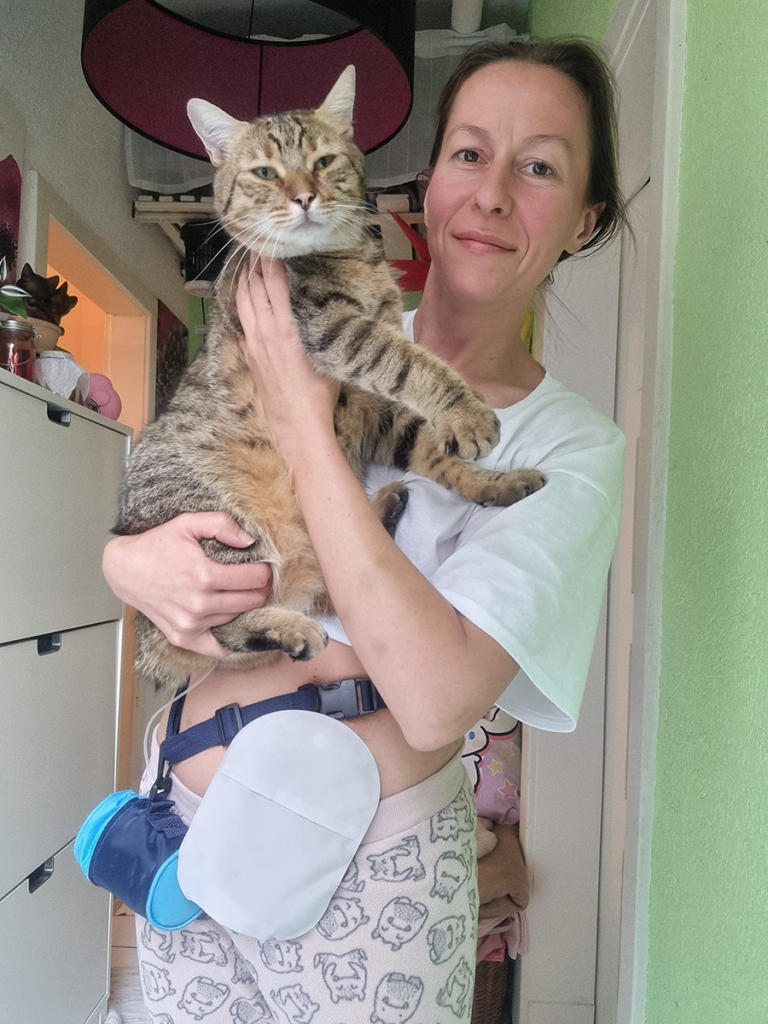
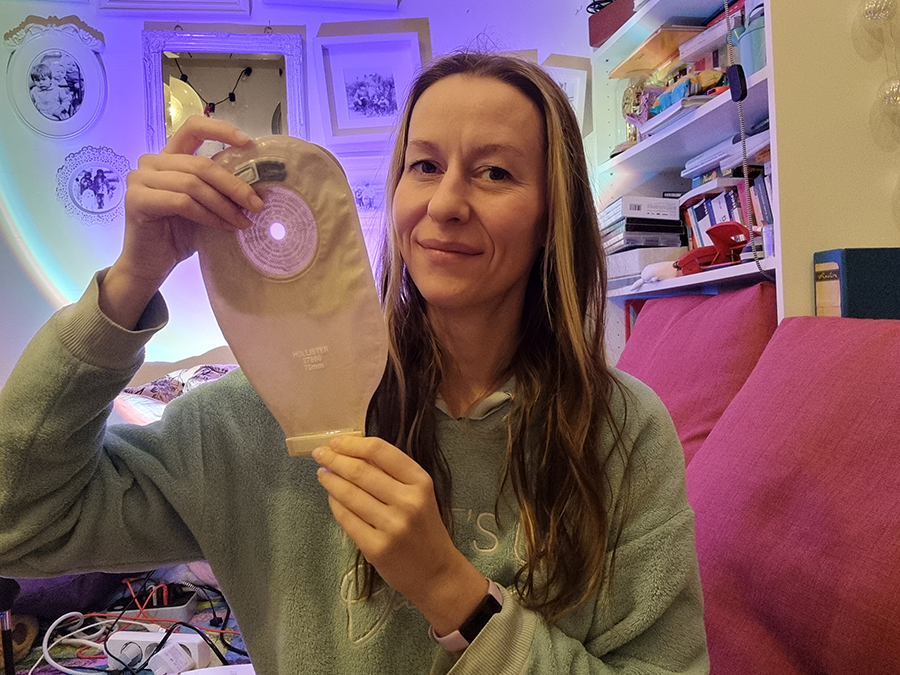
Before starting treatment, and due to the potentially life-threatening risk of a bowel obstruction, the medical team decided to create a temporary stoma: a small opening in my abdomen created during surgery to divert waste into a bag for a while. The goal was to prevent this and other possible complications during chemotherapy and radiotherapy, especially due to swelling of the irradiated tissue.
During the same surgery, my right ovary—which had become unusually enlarged—was removed. Only after the operation did it turn out to be a metastasis.
I got used to the stoma rather quickly. The daily routines soon became familiar to me. I had to learn to plan ahead and organize certain moments, but it was not too much of a burden. My surroundings accepted it quite naturally as well. Thanks to my family and friends, I never felt defined by my illness.
Treatment, step by step
From January to March 2025, after much thought and doubt, I underwent radiotherapy.
Since I didn’t know how my body would react to the treatment, I entrusted my free-roaming cats to friends, as they could bring potential pathogens into the house. I didn’t want to risk exposing my body—already weakened by chemoradiotherapy—to anything more. I could also have become bedridden, making it difficult to take proper care of them. The decision was hard and I missed them, but I knew they would return.
On May 7, 2025, the rectal carcinoma was removed during an extensive 8‑hour surgery, along with an additional round of chemotherapy. I am still very grateful to the surgeons for how well they handled it. After the operation, I spent four days in the intensive care unit. Those were the most emotionally challenging moments of my illness so far: knowing that I had been able to walk normally the day before and now couldn’t even bend a leg in bed. That was hard for me. I cried a lot in that bed. But I was also deeply grateful that the most important step was now done.
After the ICU, I stayed in the hospital for almost a month due to delayed healing. I depended on a walking aid for a long time and had to accept that my body needed a long time to recover from such a major intervention—even long after being discharged.
Following the doctors’ recommendation, I decided to undergo another round of chemotherapy. Again, it took me a long time to make this decision, as every drug with benefits also comes with long-term side effects. From July to November 2025, I went through another chemotherapy cycle. To this day, I suffer from polyneuropathy: nerve damage that shows up as cold sensitivity, tingling, and numbness in my hands and feet.
An important milestone
On February 6, I underwent the stoma reversal surgery. This was an important milestone for me—less a “return” and more a completion of the journey in a different form. I was relieved because it marked the end of a chapter, but I also knew that my body would need time and patience to adjust.
Recovery is still ongoing. My bowel is sluggish and adapts slowly to changes. I have to give my body at least three months. I still experience bowel movement issues. What began as extremely irritating stool has now shifted to another problem: due to the shortened rectum, I can’t hold my stool and must run to the toilet immediately. Both issues have been there from the start.
So healing is not only physical. I have to learn to trust my body again, to listen to it, and to respect its pace. This day felt like a turning point—a sign of how far I’ve come, and a reminder that healing happens step by step, even when the path looks different than expected.
Why sharing matters
From the start, I knew I wanted to make my journey public on social media. I am a dance teacher and know many people. I wanted to avoid unspoken questions, hesitation, or uncertainty about whether people could talk to me about it or not. I simply wanted everything to be clear.
I’ve always found strength in the stories of other patients. Recognizing yourself in someone else’s experience—especially when you face something like this at an age you never expected—helps you feel less alone and offers optimistic perspectives for yourself.
If someone reads these lines and recognizes themselves in them, then it made sense to share my story.
I am convinced that this cancer, and everything that comes with it, is only a temporary state—a transformation. I accept it and take everything that comes with it: the anger, the grief, the uncertainty, the fears, the relief of not having to perform, the freedom to manage my time more openly, the gratitude of being able to realign my focus in life, the shards, the scratches, the cracks.
But it’s okay—cracks and scratches make a little more room for a little more light.
And I want to leave you with this thought: It is not a weakness to share your pain. Your pain matters to the world. It counts. And somewhere, someone may recognize themselves in these words and find the strength to keep going. This is not an end—this is just the beginning.